Professional work · Internal platform · CRM · HR · RBAC
Operations OS
The agency’s internal operating system: tasks, projects, HR, approvals and a full sales CRM behind fine-grained permissions.
- Prisma models
- 68
- Prisma models
- source: prisma/schema.prisma
- API route handlers
- 84
- API route handlers
- source: src/app/api/**/route.ts
The problem
Work was split across chat groups, spreadsheets and paper leave forms, with no single view of who is doing what, or of the sales pipeline.
My role
- Engineered the platform: full-stack software engineering and platform development
Engineered during my role as AI & Software Engineer at Elenor Marketing Agency, Cairo (Jan 2026 – present). Screenshots come from sanitized demo environments: client and business data are replaced with demo data.
What it is
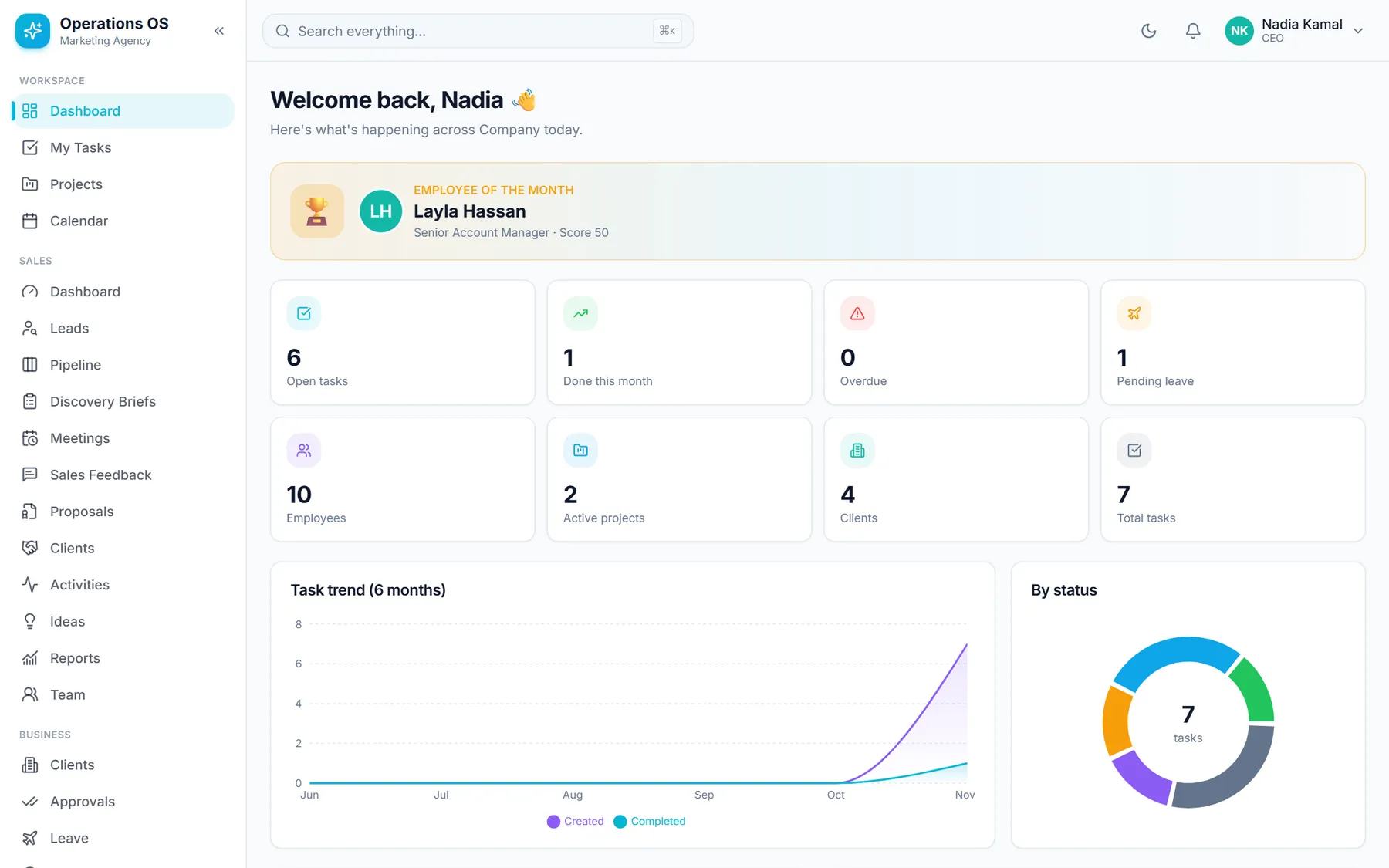
A Next.js platform with tasks (kanban, list, table, calendar), projects, clients, an org chart and departments, leave and permission requests, approvals, offboarding, an Employee of the Month scoring engine, policies with acknowledgements, an audit log, web push, a ⌘K command palette, and a sales CRM (leads, pipeline, meetings, discovery briefs, proposals, reports).
Key features
- Role → permission matrix with per-user allow/deny overrides
- JWT access tokens with rotating refresh tokens
- Command palette and web push notifications
- Employee of the Month scoring with adjustable weights
- Sales pipeline with drag-and-drop stages
Architecture
UI
- Workspace
- Sales CRM
- HR
API
- 84 route handlers
- Edge middleware
Access
- RBAC matrix
- Per-user overrides
- Audit log
Data
- PostgreSQL
- Prisma
Stack
App
Data
Platform
Engineering challenges
01
Permissions people can reason about
Roles grant permissions from a matrix, and individual users can be explicitly allowed or denied on top. Every check runs on the server, and every sensitive action lands in the audit log.
Screens
Run locally with the project’s own seed, which uses fictional people and clients.
Next project
GEO Audit Platform